
Thursday, March 19, 2020


Tuesday, November 13, 2018
Winter Online Class
My fall Object Lessons class was a lot of fun, and I've had requests to run it again this winter. If you're interested in learning more, let me know!


Monday, August 13, 2018
New Online Class — Fall 2018
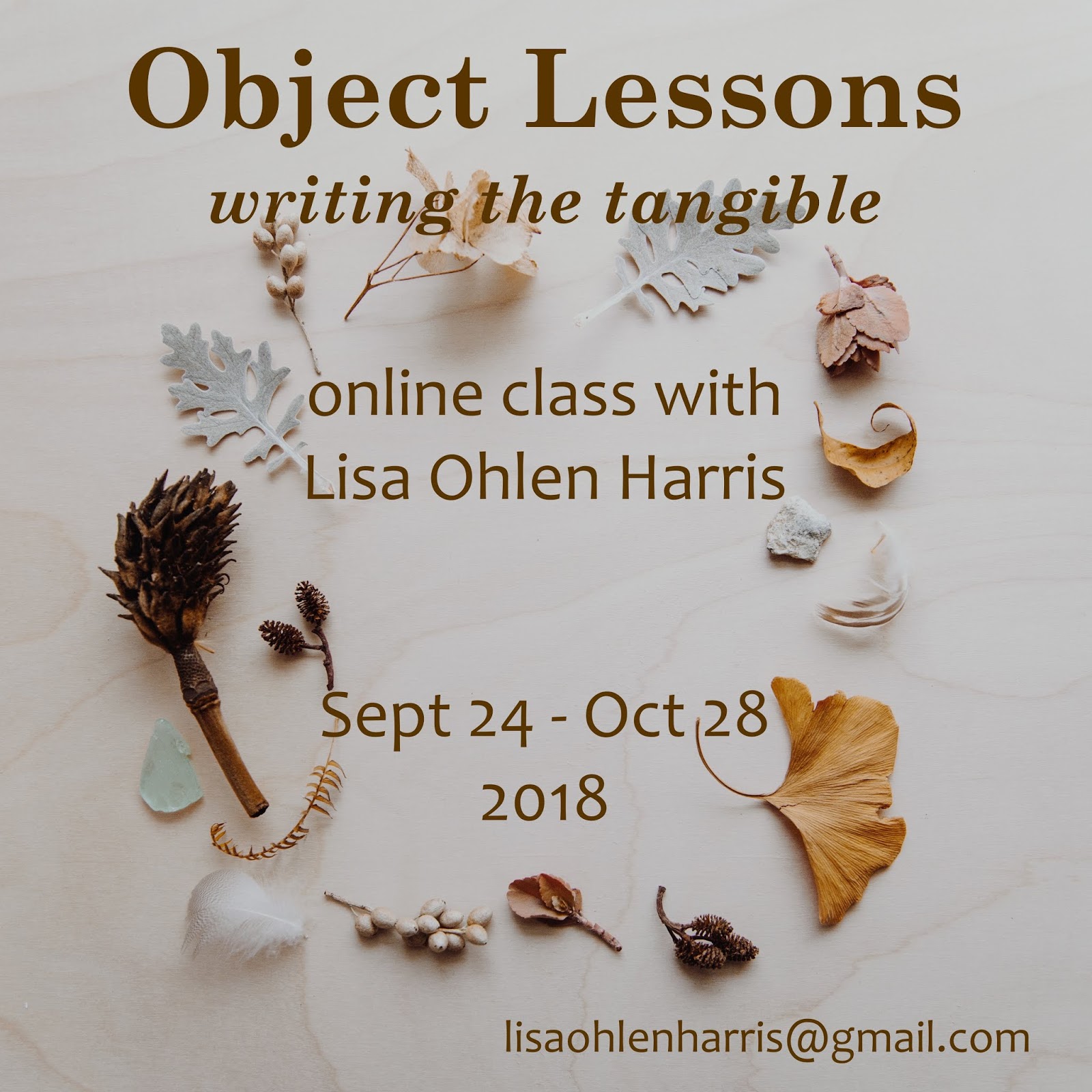
Object Lessons: Writing the Tangible
5-week online class
September 24 – October 28, 2018
Creative nonfiction brings together the concrete and the abstract, grounding relationships and emotion in the physical world and analyzing artifact in order to excavate memory and launch speculation. Through weekly readings, instruction, conversation, and prompts, this 5-week online class will look at the use of physical objects in our writing as a launching point to memory, reflection, speculation, and insight.
Week One
Setting the Stage
Week Two
Artifact as Axis
Week Three
Speculative Nonfiction
Week Four
Letters and Fair Use
Week Five
Anchoring Abstraction
Two options:
Basic (no instructor feedback) $195 early registration / $225 after September 3
Includes all class materials: readings, lectures, discussion board, prompts, optional peer review, and instructor Q&A forum
Premium $350 early registration / $380 after September 3
Includes all class materials + instructor feedback on up to 3,000 words + optional 30-minute one-on-one phone consultation with Lisa before the end of the year
We will be using the Wet Ink platform, and at the end of the course all content will be delivered to you digitally. To register for the course, shoot me an email!
Friday, March 4, 2016

Thursday, March 3, 2016
Terroir Creative Writing Festival
One November night in 2011, I drove three towns south on 99W to McMinnville, Oregon, to attend a committee meeting for a local writing festival. The meeting was nuts. So noisy and disorganized. Someone passed around wine glasses and a bottle of pinot noir, everyone talking over and under each other. I couldn't get a word in edgewise. This is ridiculous, I thought to myself. I am definitely not coming back.
You can guess where this story leads. I went back for just one more meeting in 2011 and then another in 2012, until I started to have fun. Nearly four years (and many bottles of wine) later, I adore these strong, noisy, creative writers and artists. And every spring we put on a slamming creative writing festival right here in the heart of Willamette Valley wine country.

The Terroir Creative Writing Festival takes its strange name from the French vinicultural word for all the environmental factors that go into producing a particular wine's flavor—the soil, topography, and climate. The Festival exists to cultivate writing formed of Yamhill County's terroir, though we welcome writers from all over.
Our keynote speakers this year are Shawn Levy and David Mason. Brian Tibbets from MacGregor Literary will be joining us, and we have a special workshop led by Oregon Shakespearean Festival actor JP Phillips for those who want to learn from an actor how to read their work aloud like a professional at the end-of-day open mic reading. I'll be teaching a two-hour memoir workshop in the afternoon. If you're in the area, please join us!
You can guess where this story leads. I went back for just one more meeting in 2011 and then another in 2012, until I started to have fun. Nearly four years (and many bottles of wine) later, I adore these strong, noisy, creative writers and artists. And every spring we put on a slamming creative writing festival right here in the heart of Willamette Valley wine country.

The Terroir Creative Writing Festival takes its strange name from the French vinicultural word for all the environmental factors that go into producing a particular wine's flavor—the soil, topography, and climate. The Festival exists to cultivate writing formed of Yamhill County's terroir, though we welcome writers from all over.
Our keynote speakers this year are Shawn Levy and David Mason. Brian Tibbets from MacGregor Literary will be joining us, and we have a special workshop led by Oregon Shakespearean Festival actor JP Phillips for those who want to learn from an actor how to read their work aloud like a professional at the end-of-day open mic reading. I'll be teaching a two-hour memoir workshop in the afternoon. If you're in the area, please join us!
Thursday, April 23, 2015
John D'Agata Says This About The Fifth Season
My second book meant my second chance at the Oregon Book Award—but the honor went not to me but to another fine writer, Justin Hocking, for his memoir, The Great Floodgates of the Underworld (congratulations, Justin!).
I have to be honest here. When Justin's name was announced instead of mine at the awards ceremony, I breathed a sigh of relief and all my nervous anticipation faded before the applause did. From that moment on, I was able to really listen, to relax, to enjoy the remainder of the ceremony.
And I remembered, even as Justin was giving his speech, that sometime in the next week I would receive an email with the judge's comments on my book.
John D'Agata was the judge for this year's creative nonfiction award, and here's what he had to say about The Fifth Season: A Daughter-in-Law's Memoir of Caregiving. (Thank you, thank you John.)
As I read Lisa Ohlen Harris’s phenomenally understated and yet exquisitely crafted memoir The Fifth Season, I started thinking that any lesser writer would have leapt upon this genuinely hearbreaking story and wrung it dry for every last drop of transfused misery. And then I started loving The Fifth Season even more.
Because what I have only now started to learn as a writer—embarrassingly late in the game, I’ll admit—is that it takes a lot more skill to hold back as it does to go for low-hanging and lurid details. What we learn in The Fifth Season, therefore, we learn through experience, through quietly developed anecdotes and impeccably pitch-perfect pacing, through watching Harris navigate the complexities of a relationship with her mother-in-law that neither of them seems to have voluntarily signed up for, and yet which intensifies gradually over seven long years until that relationship becomes something that beautifully transforms them both. Through genuinely heroic compassion, as well as agonizingly petty bickering, through fear and humor and unconditional patience, Harris creates a portrait of a relationship that’s about as real as it can get, and thus as strong as they come. I often caught myself envying even the worst of the moments that these two women shared.
Wednesday, March 11, 2015
McMinnville Reading and Open Mic
Join me at the Velvet Monkey tearoom on April 2 for a reading (by me) and open mic for prose writers (that means you)!

Thursday, January 29, 2015
Jill Kandel, author of So Many Africas
I "met" Jill Kandel in 2006 when she submitted a wonderful essay to Relief Journal, where I was the editor for creative nonfiction. We published that essay, and over the next few years I was not surprised to see Jill publish work in impressive journals, including The Missouri Review, Gettysburg Review, River Teeth, Image, Pinch, and Brevity. The road from writing essays to crafting a memoir is a long one, and last summer Jill learned that her years of writing and compiling and revising and then writing some more had finally resulted in a book contract: her book was selected for the 2014 Autumn House Nonfiction Prize. So Many Africas: Six Years in a Zambian Village is lyric and surprising—a gorgeous first book. I asked Jill to tell me a little about her process, and you can read the resulting interview over at Brevity!

Sunday, January 18, 2015
Oregon Book Award Finalist
I'm pleased to share that I'm a 2015 Oregon Book Award finalist for The Fifth Season! Winners in each category will be announced in April 2015.
Tuesday, December 23, 2014
Advanced Memoir & Personal Essay Class

It's not too late to register for my ten-week Advanced Memoir & Personal Essay class, offered online via Creative Nonfiction Foundation. The course begins January 12 and is quickly filling, so don't wait to register!

Saturday, December 13, 2014
Crash

You’d think I’d have
learned my lesson. The last time it happened, I had “a feeling” a few hours
beforehand and backed everything up to a thumb drive—except my photos. I lost four
years of my girls’ childhood. Not many months later, I woke early with the same
feeling and hopped out of bed to grab a thumb drive and hurry downstairs. Too
late, that second time. I lost all the remaining digital photographs of my
kids, dating back to when we bought our first digital camera when my youngest
was six months old. I have no photos of Kayla from age six months through the
time she started school. Two crashed hard drives and years of visual memories are completely gone.
That second time, I
wept.
And now it happens
to me again, with no warning, no “feeling” to presage digital disaster. I did
back everything up—including photos—just a couple of months ago, before taking
my laptop in for service, but I haven’t backed up since.
- Gone: the NaNoWriMo manuscript
- Gone: All new writing from the past few months (which isn’t saying a lot—but I’ve written more in the last three weeks than I had for six months or more prior)
- Gone: materials developed for but not yet posted in my online thesis class
- Gone: my household budget spreadsheets for the next six months
This time, the hard
drive crashed near the conclusion of a big editing project. I was in the
process of transferring my proofreader’s corrections to my master copy, but I
lost only a few hours’ work and not a few weeks’ worth. Though I hadn’t backed
up my own stuff, I had backed up my client’s work.
When I learned the
drive was a total loss, I texted my sister-in-law, who is also a writer. She
replied, “So, are you okay? I would have a good angry. Ty.”
Then 30 seconds
later: “Cry”
I haven’t had a cry
at all, haven’t wanted to, but then I do keep my emotions well buried much of
the time. Even as I drove home from the Apple store, I felt I’d dodged a
bullet. I lost a manuscript assembled out of drafts and essays still wedged
here and there on thumb drives around my bedroom and study. I didn’t lose my
power to think and to articulate. I didn’t lose a job or a home or child or parent
or my husband. The loss of 5,000 or 8,000 words of new writing is far from a
fatal error.
Perhaps I have
finally, finally learned my lesson. I’ve installed a router that backs my work
up wirelessly every hour and will store 2 terabytes worth of data. (Uh, what
the heck is a terabyte?)
The blank hard drive
on the barren laptop before me feels kind of good. I’ve chosen as my new
desktop wallpaper a blue sky with whisps of white clouds and a white crescent
moon visible through the clouds. A small handful of folders and docs are hung
on those clouds, and I know the content of each and every one of them.
The file I’m working
on today holds this coming week’s guidance for my thesis students, to be posted
online tomorrow—essentially, I’ve written a blog post focused on our topic for
the week: the writing workshop. I’d drafted the first bits of the thesis
guidance last week, but instead of trying to remember and reconstruct, I
started from scratch. Wrote something brand new. And it’s good.
Perhaps I’m in
denial, but this loss seems small. I still have hundreds of pages of
drafts on those thumb drives. I still have the urge to put fingers to keyboard. This coming Wednesday night my best friend of thirty years is coming to see the girls’ Christmas Concert,
and on Thursday my eldest flies home for Christmas Break. The tree is up, and
the shopping is done. Our furnace works. The fridge is full.
My imagination and
memory are wide and deep. I am fifty-one years old. I’ve got more than enough new material—so much left to write and
not enough weeks and months and years left to write it all.
Saturday, December 6, 2014
Mornings Unplugged

For the long Thanksgiving weekend, my family and I drove to the Oregon Coast and stayed at a cozy beach house with no Internet. The first time I stayed there, about five years ago, I was truly shocked to arrive and find there was no Internet connection, and I was mildly stressed during my entire stay. I now retreat to the beach house at least once a year, prepared to unplug and relax. It’s easier to deal with the shock when you know it’s coming.
This
discovery will come as no surprise, I’m sure: Without the distraction of the
Internet, I got tons of reading and writing done! Over the course of five early
mornings, I drafted notes for two new essays and read two memoirs and nearly
half a thick essay anthology.
Duh.
When I unplug, I get stuff done.
My
usual morning routine is to get up around six so I have an hour of coffee and
computer time before my kids get up. If I wake earlier, I get up earlier. I
poke around Facebook, read and answer emails, check my online course, and then
click back through Facebook and email again until it’s time to shower and get
dressed to take the kids to school.
What
a waste.
When
I got back from the beach, I challenged myself to use that early morning hour
(or three, on those mornings when my eyes pop open at 4:00) to read and to write without
the distraction of the Internet. I should respect my writing goals enough
to give myself those best hours, which for me are in the early morning.
So
Todd and I have been leaving the router and modem unplugged before 7:00 a.m. I
moved my morning reading and writing space from the living room to the basement
to make it harder for me to turn on the Internet just to check this one thing ...
And
of course I’ve been getting stuff done. I’ve revised a chapter from my
NaNoWriMo manuscript and am coming close to completing one of the new pieces I
drafted at the coast, which fits perfectly with the NaNoWriMo material and will become part of that larger manuscript.
I
told myself this past week of mornings unplugged was an experiment, but I know
I have to make this into a permanent habit. Writing transports me into memory and enables me to explore
connections and philosophies and relationships and spiritual convictions. When I don't write, parts
of my mind and personality fade away. I don’t experience the
world as fully because I’m not exploring my thought life as deeply.
Writing, for me, is a way of living, of experiencing life.
Writing, for me, is a way of living, of experiencing life.

Many years
ago I realized that I couldn’t eat sweets for breakfast. If I ate a cinnamon
roll or even jelly on toast in the morning, I felt spacey and slow all day. For
years now I have avoided sugar in the morning. It’s not even a sacrifice any
more.
Last
January I stopped drinking Diet Coke or diet anything. I tried cutting
processed foods as well, but I backslid on all but the soda pop and fake
sweeteners. I haven’t had any soda, diet or otherwise, in 2014. No aspartame or
Splenda. I’ve built these small habits of self denial for the sake of my body.
Now it’s time to build a new habit into the coming months and years for the
sake of my mind and heart. I already know how I will live 2015.
No
sweets for breakfast, no Diet Coke, and mornings unplugged.
Saturday, November 22, 2014
NaNoWriMo: Day 22

50,381 words, but far from done. Now to actually do some shaping and purging and augmenting!
Sunday, November 16, 2014
NaNoWriMo: Day 16

Quite
frankly, I’m ready to be done with this NaNoWriMo business. I have 48,000
words, but so what? I spend from 20 minutes to two hours a day writing (the
two-hour days are rare). The excitement of meeting the challenge doesn’t appeal to me at
all anymore, but I know that without this push and the public exposure of this blog,
I would have given up by now. If I’d given up, I wouldn’t have this crazy
assemblage of thoughts and memories, which, potentially, contains all the
ingredients needed for a book.
On
the days I write for 20 minutes—a lick and a promise—I’m ready to give up.
Maybe when I get to 50,000 words I’ll just stop, I think. But on those days
when I take a little more time—not just writing a snatch but also scrolling
through the pages, skim-reading bits, seeing that portions do hang together—on
those days I’m pretty sure there’s a publishable book in here somewhere, many
months (or years) from now. But I can only shape a book out of this stuff if I
hang out in the manuscript, if I think on it and read through it and keep on
pushing myself. If I put it aside for a week, two weeks, six months, the work
will languish. I have so many drafts, so much of my mind recorded here and
there in drafts on my hard drive. When I immerse myself enough in the manuscript,
I know I must continue.
The
second week of November, I started a big, wonderful, copyediting project that
has immersed me in someone else’s manuscript. Four, five, six hours a day, I’m
transported back seventy years. When I’m not editing, I’m pulling World War II
titles off my bookshelves—even my “breaks” revolve around this editing project!
Today is Sunday, and I’m forcing myself to rest from the editing for one day—but
I’m eager to get back to the characters who even during the copyediting process are becoming so dear
to me.
It’s
weird to move between the vast, well-structured World War II compilation I’m editing
and my own snips and drafts, not even yet adequately stitched together. I’m
frankly a lot more interested in the editing project than in my own writing. If
I hadn’t made a public commitment to this cheater’s NaNoWriMo, I would gladly
tuck my own work away for a few weeks. Which would stretch into months. I know
myself. Daily I choose to honor the potential in my writing. I choose to have a
tiny bit of faith that slow and steady will take me to the finish line, that
some of these pages deserve a home in a book, that slow deliberate plodding
will bear more fruit than manic hypergraphia.
So, however reluctantly, I will keep on writing.
So, however reluctantly, I will keep on writing.
Monday, November 10, 2014
NaNoWriMo: Day 10

On the morning of Day 7, I
received news that my dear writing mentor, Judith Kitchen, had died. That day,
I had to teach a software training session—no way I could cancel. I had an
afternoon appointment with a student writer, and I couldn’t cancel that either.
Shouldn’t life stand still when we need to grieve?
But I know better. I don’t
expect life to stand still, and I also don’t expect myself to power numbly
through. I proceeded through my day with puffy eyes, a scratchy voice, distracted
and grieving. I wore black, though in our culture that’s no sign of anything in
particular. And when I wasn’t teaching, I read.
One of Judith’s most recent
works was The Circus Train, a
novella-length essay published as a book last winter but first appearing in The Georgia Review last year. I’ve had
that issue of GR on my dresser for a
full year now, but I never opened it up and started reading Judith’s long
essay. I was waiting, for some reason.
I opened Judith’s essay and
started to read. Judith took me once again under her wing and let me into her
thoughts as she remembered her life as a girl, a young mother, a middle-aged
woman full of health and love but already squarely facing her mortality. The
year after my mother-in-law died, Judith was diagnosed with breast cancer. Each
time I saw her—once or twice a year—I wondered if it would be the last time.
But she kept rallying, kept surprising her doctors. Just weeks ago she was
hospitalized and struggling to breathe and it seemed like the end. Then she sat
up in bed and started editing poetry.
Judith kept writing through
the chemo brain fog, through breathing struggles, through weakness and
prednisone puffiness and lymphedema.
And because she kept
writing, I have access to her mind as she considered a life lived, a life about
to end. And here I am in the middle of a writing challenge, wondering if I even
want to keep writing. I certainly want to quit writing for today and for
tomorrow, and I have struggled over the past weeks and months as well.
Judith kept writing, and
because she did, I have her mind on the page. She still keeps me company, and
her words continue to speak.
Judith would have rolled
her eyes at my wimpy attitude. When I found a small publisher for my first book
and worried that I was settling for something too small, Judith shrugged. “You will
write many more books,” she said. “Publish, then write another.”
So I did. And Judith helped
me, though she was sick and weak and probably should have focused on herself
instead. She made sure I had the best second book possible—and I know many,
many other writers who are this week remembering Judith for all she was and all
we are because we had her.
I wrote a little on Day 7,
though my heart wasn’t in it at all. A few hundred words. And a few hundred
more on Day 8. Yesterday I felt just as weary, just as sad. Today is Monday and
I started a big editing job and conducted another software training and turned
in grades for my online class.
But what about the writing?
I’ve decided to make my
NaNoWriMo project into an even bigger mess. Take a couple of those essays I was
reserving for another book. Break them up and plug them into this one. If they
don’t work, fine. Nothing else is clicking, and I’m not going to throw in the
towel (until December 1).
Judith would have told me
not to reserve my best stuff for some later project. “What the hell are you
waiting for?” she would have said. So I won’t wait. I have no faith that any of
this will come together, but I won’t quit yet.
A lifetime of writing,
Judith, and it wasn’t enough. Thank you for leaving us with so much of
yourself.
Wednesday, November 5, 2014
NaNoWriMo: Day 5
A word of advice
The NaNoWriMo website gets jammed in the evening when everyone
is posting a word count. I tend to write in the morning, and I go ahead and
enter my word count as I go, even if I plan to write more later in the day. You
can update your word count as many times a day as you’d like. If I do write in
the evening, I enter that word count the next day.

What I’m learning
Keep in mind that I did not start from scratch. On Day 1 of NaNoWriMo I was already halfway to my goal. This means my daily goal is
already less than half that of a true, non-cheating NaNoWriMo participant. I’ve
been spending no more than two hours a day writing—sometimes just an hour, and
yet I’m making progress and I see the shape of the manuscript emerging in ways
I wouldn’t have if I’d just read through drafts without adding any new writing.
I can see that I need to set up a quest or Big Concern early on
and shape the book to explore that quest or concern. And I’m already getting a
good idea of what that Big Concern is for me—not something I ever considered
writing about until this month, although I see my quest there under the surface
in much of my writing to date. This is the fun part of writing—discovery!
Much (if not all) of this material will need to be rewritten
once I know better where the manuscript is headed. Creating a book out of discrete
pieces (whether stand-alone drafts, blogs, or essays) can happen in two ways (probably more than two): as a collection of discrete meditations or
essays, or as narrative nonfiction.
This writing wants to be narrative. What a surprise! When I fantasized about converting blog posts into a book, I imagined a minimum of revision. I thought I would just plunk the pieces together and voila! I love the essay, but I think I might love the
challenge of book-length narrative even more—holding the structure of years and multiple themes and threads
together and cinching them tighter in each round of revision.
I’m not yet doing the cinching, but this NaNo cheating forces me
into the manuscript each day for at least an hour or two. I skim eight or ten pages of what’s already
written, then find an access point to dip in and write. I surface again, skim,
then write some more. It’s that writing time, inside the manuscript, that helps me think, that helps me to see
the narrative threads and motifs in my life.
But the time when I’m not writing is just as valuable—maybe even
more so. Because I’m physically “into” the manuscript every day to get my word
count, I find that I’m also mentally into the manuscript while I’m going about
the rest of my day. More than once I’ve opened the file again hours after
completing my word count in order to add another thought, another paragraph,
another few hundred words.
Reading list
To help keep my head in the manuscript even when I’m not immersed in it, I’ve started a reading list, along the lines of what I see as my Big Concern in the work.
Why Place Matters: Geography, identity, and Civic Life in Modern
Times, eds. Wilfred M. McClay, Ted V. McAllister
The Body Geographic, Barrie Jean Borich
Leaving the Pink House, Ladette Randolph
Our Town, Thornton Wilder
Word count: 35,382
Our Town, Thornton Wilder
Word count: 35,382
Sunday, November 2, 2014
NaNoWriMo: Day 2

Yesterday:
Day 1
The
throat tickle I’ve had all week dripped and scratched itself deep yesterday.
Full-on cold symptoms. Awesome. But I figured if I didn’t get started on
November 1, I wouldn’t get started.
So
I sat down at my desk, opened my computer, and started cutting and pasting. I
started with blog posts from the time period I have in mind to write about. The
blog posts added up to something just under 10,000 words. I didn’t read them as
I cut and pasted. No evaluation or censoring—well, not much. The point of
NaNoWriMo is to produce raw material, isn’t it? I might not be truly producing
yet, but I’m certainly not going to start editing, either.
After
I’d harvested all I could from the blog, I went through my very messy hard
drive, searching through drafts, cutting and pasting in between blog posts as I
tried to keep things roughly in chronological order. I have so many drafts,
mostly unsorted, all over the place. It’s hard to find what I want by keyword
search any more. I didn’t take loads of time to organize, but as I searched I
also made some attempt at leaving my files tidier than I found them (thanks,
Mom). Even though I wasn’t reading the drafts, I could still see certain
friendships and places appearing and reappearing in those drafts. I resisted
the impulse to chart or measure or plan. Not yet. My only plan right now is not
having a plan.
Here’s
why. I’m afraid if I take the time to develop a plan, I’ll talk myself out of
trying to end the month with a 50,000-word manuscript. It would be so easy to
decide this stuff is boring and no one will be interested. That may well be
true, but I’m not going to make that assessment until at least December!
Day
2
I would have liked to use the extra hour from setting back our clocks to sleep,
but my cold woke me up at six—I mean five o’clock. I remembered a couple of
journal entries that might fit with my manuscript, so I added those fragments
(1,500 words) to my work-in-progress before I even got started writing for the day. And from the moment I laid fingers to keyboard, I had to banish thoughts about
how lame this exercise is and how messy the manuscript. I promised myself: no
indulging in self doubt until December. Power on through.
I started on page one of the 30,000 or so words I’d patched
together from drafts. As I read, I added some narrative and reflection and made
notes for threads to weave into later parts of the manuscript. In fits and
starts, I wrote 1,138 words—my first new writing of the month. I only got to
page 18. Tomorrow I intend to pick up there and continue reading and augmenting
my way through until I’ve got another thousand words.
Here’s my advice to myself today, starting as I am with a pretty
good chunk of manuscript already before me:
Resist deleting. When you notice repetition, leave it stand for
now. Don’t worry about tense inconsistencies or any craft decisions. Keep slapping on
more words here and there and filling out the pages with material. Just write.
Day 2
Starting word count: 31,786
Ending word count: 32,924
Words written: 1,138
Words remaining: 17,078
Words per day to finish on time: 589
Saturday, November 1, 2014
NaNoWriMo (a Nonfiction Cheater's Confession)
No, I am not writing a novel. Truth be told, all I’m doing is using the challenge (and word-count software) of NaNoWriMo as motivation to assemble a new manuscript. I’m not writing from scratch, at least not yet, but I am pulling from rough drafts, blog posts, and journal entries to see if I can put together something cohesive. What a cheater’s path to 50,000 words, right? Cutting and pasting to meet your word count. Really?
The
thing is, I’ve got all this material on my hard drive, sorted into various
nooks and crannies. Why not patch it all together and write what needs to be
written and see what happens?
Writing
is discovery, I tell my thesis students. Don’t worry about where the writing
might go or whether the project is publishable. There are no rules about how to
draft, whether in chapters or essays or one long stream-of-consciousness
paragraph. Write to figure out what you think. Write to find the meaning in the
events in your life. Write because writing feels good and because God has
gifted you. Write because it’s fun. If it’s not fun any more, then stop. But if
you talk yourself out of writing before you sit down to the keyboard, you’ll
never know if what’s inside you might become a book that will connect you to
others, that will contribute to culture, to conversation, to community.
Uh,
somewhere in the middle of the last paragraph I stopped talking to my students
and started talking to myself. So,
yeah. I’m going to do this. And by blogging my intention, I’m making it public.
I am taking a cheater’s path through NaNoWriMo by starting with a body of
work—all nonfiction.
NaNoWriMo
it is. I’m all in.
Day 1
Words written: 29,481
Words remaining: 20,519
Words per day to finish on time: 684
Friday, October 3, 2014
Ethics of the Book Review

Back in January I asked my friend Nancy to consider reviewing The Fifth Season. She declined, and we began a months-long conversation about the ethics of the book review.
I've read a number of reviews by friends or colleagues who I know have a relationship with the author they're reviewing. That's why I felt free to ask my friend Nancy to review my book. Is this really unethical? My friend Nancy says yes, and the more I think and read about the issue, the more convinced I am that she's right and that it's best for book reviewers to have no more than a passing connection to the author.
What the submissions guidelines say:
Never review the work of a personal or ideological friend or enemy. If the work is by your college professor, a classmate, a close colleague, a family member, or if the work is one with which you are associated in any fashion, please do not review it for The Bloomsbury Review.
Rain Taxi is dedicated to publishing unbiased, objective reviews. If you have a connection with the author or press, please disclose it upon submission. Not all relationships constitute conflicts of interest, but we respectfully request your candor regarding any relationships. If you are friends with an author and would like to highlight their work, please feel free to email us and suggest a review, or consider pitching an interview instead.
Writers reviewing books written by personal friends (or enemies), or from a press they hope to submit their own work to, or that has published their work in the past (or has published works of their personal friends or enemies)...you see where this is going? We hope for good ethics in the review section. If you have some connection with a press or author, be sure to disclose that to us before you write a review for NewPages.
Monday, September 22, 2014
Break into Book Review Writing

In my recent post on How to Pitch a Book Review, I said the first step is to choose a book and the second step is to choose a publication to write for. Where to start? Many book review publications assign reviews, which means they already have a stable of reviewers. The book editor decides who will review what, then shoots an email to a reviewer asking, “Hey, would you like to review this new title?”
But
how to nose your way into the stable? First of all, if you’re interested in
writing reviews, you darn well ought to be reading them. And the review
publications you read may well become the publications you write for …
eventually. If you want to write for the New York Review of Books, you’ll need
to work your way up.
Here
are some accessible book review markets with a good reputation. All of these
will consider pitches and would be a great place to start.
Make
sure to read the submissions guidelines carefully before crafting your pitch,
and you should already have a good idea of what a good book review is (and
isn’t). Here are some rules of thumb.
- Don’t review books by friends or colleagues (I’ll talk about this more in my next post)
- Quote from the book’s content not the flap copy (flap copy or sell copy is the descriptive text on the back of the book or on the bookseller’s website)
- Cover the book’s strengths as well as weaknesses (a pan is no fun for anyone and only displays the reviewer’s superiority)
- Be respectful, not condescending
- Stick within your area of expertise (I won’t review fiction or poetry, for example)
- Read the book you’re reviewing (duh, right?). Cover to cover
- Write a review, not a report. Don’t just summarize the book’s content. Respond to style, structure, effect, and contribution to the larger cultural conversation on the subject of the book you’re reviewing.
Here
are a handful of publications accepting pitches from reviewers. If they like
your work, you’ll be added to their stable of reviewers, where you can receive
assignments, write and publish reviews, and gather clips for future use when
pitching reviews to new publications.
Can you suggest other publications where a writer might break in with a first book review? Please mention them in the comments section, and I'll add them to the post.
Subscribe to:
Posts (Atom)